
Exhibition presented by Carole Jeanneret
from the "Open Book" workshop
24 Rue de Lausanne in Fribourg
"The mission of the conservator/restorer: what if your books could last another 100 years?"
From June 3 to 27, 2026 at L'Atelier, Place Notre-Dame 16 in Fribourg

Handling rules
List of tips to help you when handling and moving your documents and books.
Rules for handling paper documents, parchments and books.
• Always wash and dry your hands thoroughly before and after each handling.
• Avoid touching the writings, prints, paintings and illustrations as much as possible.
• Do not talk, eat, drink, lean on, or handle a work of art.
• Do not wet your fingers to turn a page or to grasp the edge of a work.
• Do not pile works and books on top of each other; however, if necessary, place the
The least sensitive and heaviest works are at the bottom.
• Be conscious and attentive to each gesture during handling, always handle each piece with both hands.
• Be stable and have unloaded arms when picking up or moving a work of art.
• All 2D artworks made of flexible materials must be placed on a rigid support which will serve as
support for movement.
• As soon as they are removed from their storage container (shelves, drawers or other), all books and documents must be placed on a support (such as a storage box or a sheet of acid-free paper) or a soft cloth to prevent any damage.
• Always adjust the dimensions of the support and conservation boxes in relation to the artwork or the
book to be moved (of the same size or larger).
• When handling, prioritize handling on the covers or edges of the works.
• Use a trolley for transporting artworks within an institution.
• Do not handle paper works with plastic or cotton gloves.
• Gloves should only be worn when handling photographs or books bound in leather or parchment.
• Prioritize storing and moving books and storage boxes flat.
• Regarding books, they should never be picked up by the cover and opened at more than 120° degrees (provide foam or a rolled-up cloth to hold the book during consultation).
• If they are stored vertically on a shelf, allow sufficient space between the volumes in order to
to be able to remove them without grabbing them by the crown or back and without creating friction between their
covers.
• Separate and place the sheets, softcover comics, or other booklets in permanent paper sleeves before stacking them in a storage box adapted to the dimensions and storage needs.
Here are some schematic examples of what should be done, or conversely, what should be avoided:
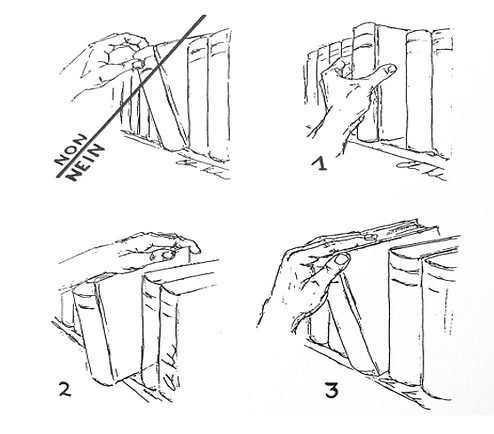
Illustration of good book handling methods

Books warp due to lack of lateral support

Warping of a paperback book improperly placed on the shelf. Warping of brochures stored in boxes.
Let's work together
If you are interested in our conservation/restoration services, you can get in touch via the form below or visit our store at 24 rue de Lausanne in Fribourg.