
Exhibition presented by Carole Jeanneret
from the "Open Book" workshop
24 Rue de Lausanne in Fribourg
"The mission of the conservator/restorer: what if your books could last another 100 years?"
From June 3 to 27, 2026 at L'Atelier, Place Notre-Dame 16 in Fribourg
_edited.jpg)
Dry cleaning
What is this ?
Dry cleaning is a conservation operation which consists of removing dust and superficial soiling from a document without the addition of water or solvents, in order to preserve the integrity of the support as much as possible before any restoration.
Why clean first?
Before any restoration work begins, cleaning the document is an essential step, as it removes dust, surface dirt, and any deposits that could hinder observation of the object or compromise subsequent operations. Dry cleaning, carried out using gentle mechanical methods, is often the preferred first step. It allows the surface to be treated without the introduction of moisture, making it particularly suitable for fragile documents, sensitive inks, and substrates whose stability is not guaranteed. This step improves the document's legibility and also limits the risk of spreading dirt during subsequent handling. Dry cleaning is therefore an important preliminary step in document conservation.

Dry cleaning a book with a broken seam
Work created by © Carole Jeanneret in 2021
For the paper
On paper documents, dry cleaning primarily targets the surface: dust, light grease deposits, and loose soiling. This can be followed by more thorough dusting if the document's condition allows, but always without aggressive rubbing, as this can pull out fibers or spread stains.
For the parchment
Parchment requires even more care, as it reacts strongly to humidity. Dry cleaning is often preferred after verifying the stability of the inks and colors, using brushes, very soft erasers, or highly controlled erasing processes.
Key takeaways
Thus, cleaning is not simply a maintenance operation. It is an integral part of the diagnosis and restoration strategy. When well-chosen and correctly executed, it prepares the document for subsequent interventions while respecting its materiality, history, and stability as much as possible.
A good cleaning is always accompanied by good protective equipment for the conservator (see the mannequin in the exhibition), that is to say: a suitable protective mask, gloves and a blouse (or apron) to protect themselves from old dust which can be harmful to the health of the person performing the cleaning.

Dry cleaning a particularly dirty canvas-covered martini board
Work created by © Carole Jeanneet in 2017
The necessary equipment:
For paper, a soft brush, a flexible vinyl eraser, or a latex sponge is often used to remove surface dust and dirt. For books, this work is done very carefully, page by page or area by area, taking care not to damage the pages, inks, or binding.
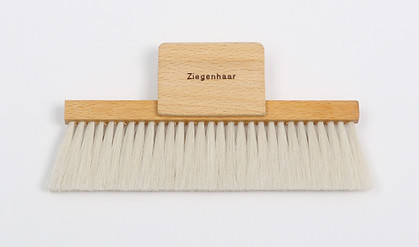
Soft brush for dusting works of art on paper and parchment
Image © GMW Shop
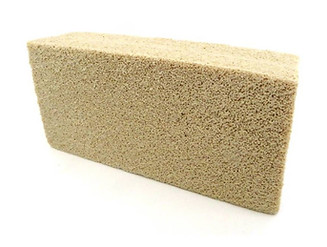
Latex eraser for erasing works of art on paper and parchment
Image © Promuseum

Foam eraser known as "Whishab" for erasing works of art on paper
Image © CXD France
Let's work together
Contact us so we can work together.


