
Exhibition presented by Carole Jeanneret
from the "Open Book" workshop
24 Rue de Lausanne in Fribourg
"The mission of the conservator/restorer: what if your books could last another 100 years?"
From June 3 to 27, 2026 at L'Atelier, Place Notre-Dame 16 in Fribourg

The paper
Paper, a material born from innovation

Frise chronologique de l'histoire du papier ©Carole Jeanneret
His Story
Paper is a familiar medium today, ubiquitous in our daily lives, but its history is long and fascinating. Before its appearance, civilizations used other writing materials such as papyrus and parchment, which already met the need to preserve and transmit knowledge. Paper as we know it is generally attributed to China, where its manufacture was developed at the beginning of our era, then perfected by Cai Lun in 105 AD.
Made from plant fibers, paper first spread throughout Asia, then reached the Arab world before arriving in Europe several centuries later. Its adoption profoundly transformed the circulation of ideas, administration, education, and written culture. Long produced by hand, it entered the industrial age at the end of the 18th century with the mechanization of its production.
From a handcrafted support to an industrial material
For centuries, paper was produced by hand from rags, linen, hemp, or other plant fibers. This slow manufacturing process resulted in sheets that were often very strong and sought after for writing and printing.
From the 19th century onwards, production changed profoundly with the introduction of wood pulp, which allowed for faster, more abundant and less expensive manufacturing.
This evolution has made paper much more accessible, but it has also altered its physical properties and durability. Rag paper is generally more stable and longer-lasting, while wood pulp paper can be more susceptible to aging, acidity, and yellowing.
Over time, paper has diversified to meet a wide range of uses: writing, drawing, printing, packaging, preservation, visual communication, and artistic creation. Its qualities have adapted to the technical, economic, and aesthetic needs of each era.
Even today, despite the rise of digital technology, it remains an essential material, at once practical, cultural, and symbolic.
A material that is still alive
The history of paper is that of a material that has accompanied the evolution of human societies. Born from artisanal know-how, it became a major tool for disseminating knowledge, then a universal industrial medium. Its journey illustrates the intersection of technical innovation, cultural transmission, and everyday use.
The various papers

Kozo and Gampi paper sheet
Image from internet © FineArtStore.com

Making a Washi sheet
Image from internet © awagami factory in Tokushima
Asian paper
- Hemp
- The Kozo
- The Mitsumata and the Gampi
Dating : Around 160 BC.
Composition : 100% plant fibers
Production : The plants are soaked in water, then the stems are beaten with a mallet. The fibers are placed in a large vat to be mixed with water and glue (obtained from ground roots). A mold is then dipped into the vat to collect the fiber pulp and form the leaves, which are then dried in the sun.
The resulting sheet is homogeneous but it may sometimes contain residues of bark or poorly refined fibers, called "andouilles".
Conservation : This plant-based paper, due to its fibers and sizing, is very vulnerable to wood-boring insects and microorganisms. Furthermore, this paper is fragile and difficult to handle.
Les différents papiers
Arabic paper
Dating : From 751 AD.
Composition : 100% cotton, linen, or hemp fibers
Manufacturing :
The manufacturing process is the same, but with different raw materials: local hemp, flax from Egypt and the Spanish Levant, and cotton. The artisans notably had the idea of recycling old cotton rags to transform them into paper pulp.
The sizing process takes place after the sheet has been formed: it is soaked in a bath of wheat starch-based glue. Once dry, the surface of the paper is smoothed with a stone to reduce any irregularities in the relief.
The resulting sheet is homogeneous, but thicker than Asian paper.
Conservation : This paper is very vulnerable to wood-boring insects and microorganisms.

Photograph of an Arabic manuscript
Private collection from Morocco © Identify and preserve your old papers by Olivier Maupin
Laid linen rag paper

Engraving illustrating innovations in stationery
Image from internet © Georg Andreas Böckler, Theatrum machinarum novum...
Dating : From 1336 to 1860
(Arrived in Europe via Italy in 1272, but the Church rejected this Arabic paper of Muslim and pagan origin, which was fragile and delicate to store. Paper took time to surpass parchment).
Composition : 100% cotton or linen rag fibers
Manufacturing : It is mechanized thanks to several innovations:
The arrival of the steam hammer, powered by the hydraulic force of the waterways.
Pressing under a press and wringing each sheet between two wool felts.
The sizing, now animal-based.
The drying process no longer takes place in the sun but on a clothesline.
The creation of the wooden and brass form, which allows the mass production of sheets.
At the end of the 17th century, the Dutch designed a much faster rag pile, which made the work easier. The French began using it around 1780.
The resulting sheet of paper, of varying thickness, is laid: the marks of the brass paper-making machine are visible when held up to the light. Paper traceability quickly became a government requirement for controlling written documents; thus, papermakers had to sign their production with a watermark, a design visible only when held up to the light.
Conservation :
The use of iron in papermaking leaves metallic particles in the sheets. This causes oxidation spots if there is excessive humidity in the surrounding air, or if damp rag paper comes into contact with cardboard or an acidic wood surface. The side of the sheet in contact with the acid then hydrolyzes, forming small reddish-brown spots. This is known as foxing.
The difference in thickness of paper pulp on the same sheet also causes deformations and warping.
This paper is also susceptible to mold and wood-boring insects.
Modified rag paper
Dating : From the 18th century to the present day
Composition : 100% cotton or linen fibers + chemicals
Manufacturing :
Rags became difficult to obtain; therefore, trials were conducted with new materials such as tree leaves, hemp, cow dung, and straw, without success. Chemical processes were then developed to wash the rags: chlorine in 40% water, and then, from 1850 onwards, a soda crystal wash in a rotating boiler heated to 135°C. To make the paper opaque and printable, mineral fillers such as talc, calcium carbonate, or kaolin were added.
In 1798, Louis-Nicolas Robert invented a continuous paper-making machine, marking the beginning of industrial paper production. This 6-meter-long machine could produce approximately 960 meters of paper per day.
Its mechanical fragility requires printers and engravers to use the highest possible paper weight to ensure good printability.
The paper is more flexible and has "bumps," making it heterogeneous. It is whiter when manufactured.
Conservation :
The use of chemicals in papermaking leads to a loss of mechanical strength. The sheet becomes more porous and therefore more susceptible to foxing, resulting in larger spots, hence the name "bull's-eye." Furthermore, the addition of alum, intended to facilitate gelatin sizing, makes the paper more brittle.
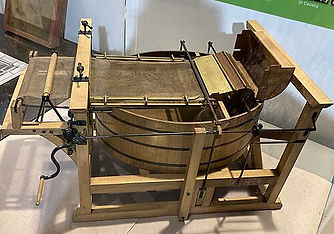
Reproduction of Louis-Nicolas Robert's continuous paper-making machine
Photograph © Frogmore Paper Mill, England

Periodical made from 100% wood fiber pulp paper
© Carole Jeanneret in 2026
Mechanical wood pulp paper
Dating : From 1802 to the present day
Composition : 50% wood fibers / 50% cotton or linen fibers
then 100% wood fibers
Manufacturing : Rags became scarce and very expensive; the idea of using wood fibers emerged in England in 1802. Then, wood pulping machines were invented in Germany as early as 1844, but the paper lacked quality. Papermakers then had the idea of combining the old rag pulp with this new, economical process.
In 1867, a new, efficient pulping machine capable of continuously recycling wood pulp waste appeared. It finally made it possible to produce paper made entirely from wood (80 kg of paper per 100 kg of wood). This new paper, at a competitive price, was used for making newsprint and periodicals.
The resulting sheet of paper is heterogeneous and its surface is very smooth on both sides. When held up to the light, the paper displays cloud-like patterns.
Conservation :
Paper contains lignin, which binds the fibers in the wood and reacts strongly to ultraviolet light, causing significant yellowing.
The paper fibers are short, resulting in a lack of flexibility and elasticity in the sheet. However, its low absorbency makes flatbed printing easier.
Another preservation problem: from its very manufacture, paper has a low pH of around 6, making it highly acidic. Improper storage (humidity fluctuations, light, dust, etc.) accelerates the degradation process, making the paper very brittle.
Paper made from chemical and mechano-chemical wood pulp
Date : From 1854 to the present day
Composition : 100% wood fibers
Manufacturing :
To obtain white paper, chemical additives are used during the wood pulp paper manufacturing process, such as dissolving caustic soda. However, the loss of raw materials is significant (approximately 65% per 100 kg of wood).
From 1880 onwards, calcium bisulfite acid was used successfully; however, this resulted in a significant loss of mechanical strength of the paper.
Finally, papermakers add mineral fillers (kaolin, talc, calcium carbonate, etc.) to the pulp. These improve dimensional stability, but they are very sensitive to humidity and detach from the paper surface, resulting in a loss of legibility.
The sheet of paper made from chemical or mechano-chemical wood pulp has a homogeneous surface and a powdery transparency. Its surface is smooth on both sides. The paper shows cloudy patterns when held up to the light and is brittle.
Conservation :
This paper is stronger than chemical wood pulp paper and is better suited to all kinds of printing, but it is more expensive than the latter.
However, it is subject to foxing, of the same intensity on both the front and back of the sheet.

Canvas-backed map made of chemical pulp paper
wood
© Carole Jeanneret (Work completed in 2024)
Let's work together
Contact us so we can work together.