
Exhibition presented by Carole Jeanneret
from the "Open Book" workshop
24 Rue de Lausanne in Fribourg
"The mission of the conservator/restorer: what if your books could last another 100 years?"
From June 3 to 27, 2026 at L'Atelier, Place Notre-Dame 16 in Fribourg

The parchment
What is this ?
Parchment is a very ancient writing material, made from carefully prepared animal skins, most often sheep, goat, or calf. Its name is traditionally associated with the city of Pergamon in Asia Minor, where its use is believed to have developed in the 2nd century BCE, although its manufacture is probably older. More durable than papyrus and able to be folded, cut, and bound, it gradually replaced other writing materials in Late Antiquity and the Middle Ages.
In the Middle Ages, parchment became the preferred material for manuscripts, charters, and precious books. Its strength, flexibility, and ability to be written on both sides made it particularly well-suited for copying texts. It thus played a vital role in the transmission of knowledge before being gradually replaced by paper from the 12th century onward in Europe.
Parchment was also widely used for book coverings. In bookbinding, it served to protect the text block while providing structure, particularly in soft or reused bindings. It was sometimes used alone, sometimes with boards, and it could come from fragments of older manuscripts recycled to cover everyday books. This practice, common for liturgical, legal, or administrative books, demonstrates how parchment was for a long time both a writing surface and a protective material for the book.
From a conservation-restoration perspective, parchment presents unique characteristics that demand special attention. Being hygroscopic, it reacts strongly to variations in humidity and temperature, which can lead to deformation, tension, warping, or shrinkage. Its restoration therefore requires a thorough understanding of its material behavior in order to respect its structure and minimize invasive interventions. Preserving a parchment book thus means considering its historical, technical, and material dimensions.
Parchment holds an important place in the history of the book, both as a writing surface and as a covering material. Made from carefully prepared animal skins, it was widely used in medieval manuscripts because of its strength, flexibility, and ability to accept ink on both sides. Its origins are generally associated with antiquity, and its use developed particularly significantly in the medieval world.
In the field of bookbinding, parchment has long been used to cover books, either alone or in combination with other materials. Its good mechanical strength, its understated appearance, and its relative resistance to handling made it a popular material, particularly for softcover bindings, repurposed bindings, or certain conservation bindings. Parchment covers can still be found on old books today, sometimes used to effectively protect the text block while also providing a certain material elegance.

Parchment after it has been flattened and restored
© Carole Jeanneret (Work completed in 2017)
For further information, here is the report of the conference on parchment presented by Carole Jeanneret in Porrentruy in 2025 as part of "The Bible of Moutier-Grandval makes its return to the Jura" in 2025.
The story of the parchment
Egypt held a monopoly on papyrus, and the kings of Pergamon faced significant supply difficulties. To overcome this problem, they encouraged the production of parchment (a word meaning "skin prepared in Pergamon") as early as the 3rd century BC, enabling them to continue developing their library, which contained two hundred thousand volumes. Parchment supplanted papyrus by the 4th century AD. However, it did not appear in Europe until the 7th century.
Made from sheep, calf, or goat skins treated with lime water and then polished with pumice stone after drying, parchment is stronger than papyrus. It can be written on both sides and scraped for reuse. This practice was common, especially during periods of scarcity in the Early Middle Ages: it was then called a "palimpsest," a term of Greek origin meaning "scraped again." Writing on parchment was done with a quill pen made from a goose, crow, or eagle feather. The ink remained the same as that used for papyrus (ink made of water, gum, and lampblack), as metallic salts were not used in ink production until the 12th century.
Between the 1st and 4th centuries AD, parchment, being flexible and pliable, allowed the cylindrical book, or Volumen (which unrolls horizontally) or Rotulus (which unrolls vertically), to become a rectangular prism and take the name "Codex": sheets of parchment, calibrated and folded, were gathered to form quires which were then sewn together, sometimes with a protective parchment cover. This evolution represents the true birth of the book, and simultaneously that of bookbinding (from "re ligare," meaning "to bind again").
The title initially remained at the end of the text, then, from the 5th century onward, was placed at the beginning. Pagination, though necessary, was rarely used. On the other hand, the codex was more often illustrated than the volumen. The two forms of the book coexisted for some time, then the obvious conclusion became clear: it was infinitely easier to leaf through a codex than to unroll a volumen.
Parchment can be made wherever cattle are raised. And even though it is still expensive – several animals must be sacrificed for a single pound, and several weeks of preparation are required – the best quality is called "Velina": obtained from the skins of stillborn calves, it is thinner.
The making of parchment
Parchment is animal skin (sheep, calf, goat, donkey, antelope, etc.) that is treated to obtain a very strong material.
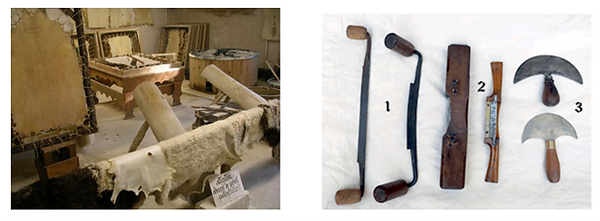
The parchment maker's workshop and his tools
Royalty-free image, internet
Here are the steps involved in making parchment:
The washing process : After the animals are skinned, the hides are washed under running water and then immersed in a bath of quicklime (crushed and calcined limestone). This bath corrodes the tissues, causing the hair and epidermis to detach. It is the dermis, the underlying tissue that is not affected by the lime, that will become the parchment. After about a month, the hides are removed and worked on both sides: the grain (hair side) and the crust (flesh side).
Deburring : consists of removing the down and hair by scraping with a concave knife, called a heel knife or peeler, the hides spread out on a trestle.
Effleurage : to remove the epidermis.
Second washing : the hides then go into a second bath of water and lime and are stretched on large upright wooden frames.
Fleshing : using a fleshing iron with a round blade, they are scraped and rid of the last pieces of flesh.
The framing : A simple white and flabby dermal layer, the skins are stretched over another flat wooden frame to fix its elasticity.
Backing : the almost dry skins are coated, on the crust side, with chalk powder which absorbs the grease and allows the whitening and opacification of the parchment and facilitates the two final following operations.
Scraping : thinning the skin on the crusty side by removing shavings.
Sanding : a meticulous operation carried out on dry skin, using pumice stone, on both sides. Left under pressure "with a pestle" for some time, the parchments are finally cut as needed.
The decoration of the parchment

"If you don't know what writing is, you might think the difficulty is slight, but if you want a detailed explanation, let me tell you that the work is hard; it blurs the vision, bends the back, crushes the stomach and ribs, grips the kidneys, and leaves the whole body aching."
Colophon of Silos Beatus, 12th century.
Image of a scriptorium in the Middle Ages
Excerpt from the Viking series, History Channel Canada, Season 1, 2013
The writing and decoration of manuscript pages were carried out in a scriptorium (a workshop for scribes and illuminators). Usually located near the library, the scriptorium might be in the only heated room, called the "warming room," or in a series of small individual cells. In the poorest monasteries, the scribes were housed in the cloister.
Each scribe had a seat (although some work was done standing) and a double-sloped writing desk. They wrote using a quill pen, regularly sharpened but with different nibs depending on the desired script. Each scribe could complete an average of four folios per day, that is, four sheets measuring 35 to 50 cm high by 25 to 30 cm wide. A manuscript of 200 folios, or 400 pages, took approximately two and a half months to write.
The tedious work of copying was interrupted only by times of prayer and resulted from teamwork:
Novices, apprentices, and beginners were responsible for drawing the lines, the "pre-settings," on which scribes would align their letters. Many manuscripts exist where these pre-settings have not been erased.
The best calligraphers were responsible for the most meticulous writing. The copyists likely worked from dictation and in groups on the same work.
Miniaturists and illuminators were specialists in book decoration. Not all books were necessarily painted or gilded. These embellishments were found in luxury editions.
The Illigatorliborum, the bookbinder, was responsible for binding the set of parchment leaves and creating a sturdy cover with very finely crafted clasps.
When a monk claimed his work as a personal masterpiece, he was forced to abandon his work until he humbly accepted that his art was placed solely at the service of God and his religious order.
Illumination
Illumination refers to the art of decorating and illustrating manuscripts or books. Illuminations can be found throughout the manuscript, including in the margins. It encompasses various decorative elements, such as:
Initial letters (ornamental capital letters)
Borders and marginal bands
Decorative compositions
The oddities or grotesques (fantastic creatures in the margins)
The miniature
A thumbnail is usually a separate illustration inserted within the text or on separate pages. More specifically, it refers to:
An independent figurative painting in a manuscript
A rectangular or square illustration decorating a page
A small, self-contained painting
Illumination is primarily used to embellish and structure the text, while miniatures provide a more elaborate visual and narrative dimension.

The Carrying of the Cross
Photograph © National Library of France
Use of parchment in medieval books
Rare and precious, the manuscript arouses much covetousness. The book is most often reserved for the two orders that dominate society: the clergy and the nobility.
Produced through a long and complex manufacturing process, even the humblest manuscript reached a price high enough to make it a luxury item, reserved for a privileged few. It is estimated that a large-format Bible cost around 20 pounds, equivalent to the annual income of an average lordship at the end of the Middle Ages or the price of a farm today.
Parchment is a very expensive raw material and is therefore reused in various ways:
for the pages of the book
for the cover pages
for the reinforcement bars on the spine of the book
for the cover

Cover created using a page from an antiphonal.
© Carole Jeanneret (Work completed in 2022)

Bindings on the spine of a book from 1256
© Carole Jeanneret (Work completed in 2023)
Furthermore, the parchment can also be scraped on the surface in order to be rewritten or corrected. These are then called "Palimpsests" ("scraped again").

Roman law document amended multiple times
© Carole Jeanneret (Work completed in 2023)

During the Arno River flood in Italy in 1966, a large number of parchment books and documents were saved because they floated. Since then, this material has been used to make protective covers for books that require them. Parchment, being a very strong, waterproof, and lightweight material, allows books to be preserved in optimal conditions over the long term.
Parchment conservation cover
© Célia CASAL - Contemporary handcrafted bookbinding
Damage to the parchment
The most common types of damage are:
A warping, or even a rolling of the parchment upon itself
Tears or cuts in the parchment, sometimes original, which were reinforced by stitching at the time of creation
Material shortages, called gaps
Local fragility resulting from the scraping of the material in the case of Palimpsests
The parchment broke due to the rigidity of the material being subjected to tension.
Mold growth and the appearance of transparency upon exposure to water
Stains from wax applied to it, especially when the parchment is placed near a heat source (fireplace or stove)
Holes left by insects (keratinophages, woodworms, silverfish, booklice)
Conservation and restoration of parchment
To ensure the proper preservation of a parchment document, whether in a book or not, it is necessary to provide the most stable environment possible for the storage location of the work.
The ideal temperature ranges from 15.5°C to 21°C (60°F to 70°F) with a relative humidity between 55% and 65%. It is crucial to avoid rapid and significant changes in temperature and humidity, as these can cause deformation and irreversible damage.
Parchments must be protected from UV rays and direct sunlight. Prolonged exposure to light can cause discoloration and damage. Finally, parchments should be stored flat in suitable storage boxes.
Several interventions are possible for the restoration:
Dusting with a soft brush and scrubbing with a latex eraser.
Parchment covers can be cleaned with synthetic saliva.
Laid flat under Gore-tex
Consolidation of tears and gaps with Japanese paper inspected according to recommended conservation standards or with balloon skin. Use of 5-7% gelatin glue or 3% sturgeon glue.
Light coloring of the material fillings with a mixture of watercolor and a little methylhydroxyethylcellulose (also known as Tylose).

Folded and warped parchment before restoration
© Carole Jeanneret (Work completed in 2017)
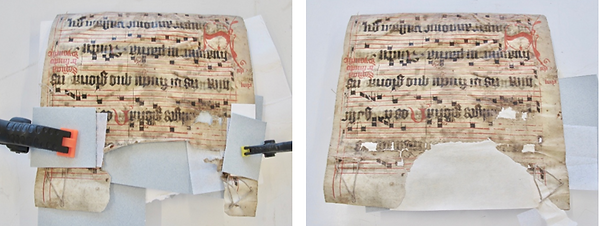
Parchment covering during and after restoration
© Carole Jeanneret (Work completed in 2023)

Dusting off a parchment
© Carole Jeanneret
Let's work together
Contact us so we can work together.


