
Exhibition presented by Carole Jeanneret
from the "Open Book" workshop
24 Rue de Lausanne in Fribourg
"The mission of the conservator/restorer: what if your books could last another 100 years?"
From June 3 to 27, 2026 at L'Atelier, Place Notre-Dame 16 in Fribourg

The color retouch
What is this ?
Color retouching is a conservation-restoration technique that aims to restore the aesthetic legibility of the restored artwork. It must absolutely respect the material and historical integrity of the object.
In the case of works on paper
Color retouching is carried out before filling the gaps. It is done directly on the Japanese paper used for the grafts. This approach allows the restored areas to be visually integrated before their final placement. The preferred technique relies on the use of watercolor paint, mixed with a small amount of Tylose, which acts as a binding agent while maintaining a degree of reversibility. After the structural restoration, the retouching can be refined to achieve a more subtle and nuanced result. This additional phase may involve dry materials such as pastel, also mixed with a little Tylose to improve its adhesion, as well as colored pencils, allowing for precise and controlled work on details.
For parchment-based materials
Color retouching also takes place before filling the gaps and is applied directly to the Japanese paper intended for restoration. However, due to the parchment's particular sensitivity to humidity and changes in humidity, extra care is taken to control the mediums used. Watercolor is also employed here, but always combined with a small amount of Tylose to fix the color and limit its spread. This precaution is essential to prevent any migration of pigment into the original parchment, which could irreparably damage the surface of the artwork.


Paul Colin poster before and after filling in gaps and color retouching
The Japanese paper was tinted with watercolor before being incorporated into the work, then the details were done with dry pastel and colored pencil.
© Carole Jeanneret (Work completed in 2022)
For book covers
Regarding books, color retouching is generally carried out after the gaps have been filled and all other restoration work is complete. This timing allows work to be done on a stabilized and homogeneous surface. The preferred technique involves localized acrylic coloring, chosen for its coverage, stability, and ability to adapt to the various substrates found in bookbinding structures and printed pages. The intervention remains targeted and measured, respecting the principles of discernibility and reversibility that guide conservation-restoration practice.
Thus, although based on common principles, color retouching adapts to the specific characteristics of each type of support, both in the timing of the intervention and in the materials and techniques employed. It contributes to the visual restoration of the artwork while adhering to a rigorous ethical approach inherent to the discipline.
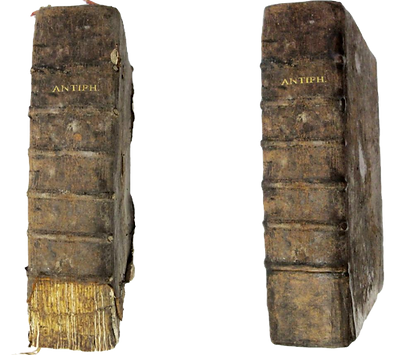
Spine of an Antiphonary, a music book, before and after restoration and local coloring with acrylic paint
© Carole Jeanneret (Work completed in 2023)
Color retouching in conservation-restoration: between institutional ethics and workshop freedom
Color retouching is one of the most delicate and debated stages in the restoration of works on paper, parchment, and antique books. Its aim is to reintegrate lost material (gaps, erasures) in order to restore the legibility and visual harmony of the object, without altering its historical authenticity. However, the implementation of this technique varies considerably depending on whether the conservator works within a public institution (museum, national library, archives) or in an independent workshop.
In an institution
In public institutions , the process is governed by a rigorous and codified ethical framework, often inspired by international charters such as the Venice Charter or the guidelines of ministries of culture. The institutional approach prioritizes the "reversibility" and "legibility" of the intervention. Retouching is generally carried out using a "pointing" or fine hatching technique, employing mineral pigments or specific watercolors, so that the retouching remains distinct from the original at a normal viewing distance (the "correction" rule). The objective is not to deceive the eye, but to reduce visual fatigue for the viewer confronted with gaps, while preserving the ability to distinguish the intervention from the original material. Documentation is exhaustive: each intervention is photographed before, during, and after, and the materials used are traceable over the long term. The pressure for perfect integration is often less than for historical readability, because the institution's mission is first and foremost the preservation and study of the work for future generations.


A3 poster showing before and after color retouching for an institution
©The Fribourg Firefighters' Galetas (Work carried out by Carole Jeanneret in 2026)
In an independent workshop
Conversely, independent workshops , often working on private commissions (collectors, auction houses, private owners), sometimes adopt a more pragmatic or aesthetic approach. While adherence to the basic principles of restoration (reversibility, compatibility) remains the norm for serious professionals, the scope for interpretation can vary. In certain cases, particularly for objects intended for display in a domestic or commercial setting where aesthetics are paramount, retouching can be carried out with a more seamless integration, aiming for immediate visual harmony that sometimes approaches aesthetic "rehabilitation." The requirement for exhaustive documentation is sometimes less stringent, although professional standards always mandate a report of intervention. Furthermore, independent workshops often face tighter deadlines and specific budgets, which can influence the choice of techniques or the extent of the retouching. It is important to note that this distinction does not imply that independent workshops disregard professional ethics. Certified conservators, whether institutional or independent, are bound by the same fundamental principles of not obscuring the original and of reversibility. The difference lies more in the philosophy of the object's end use: a work in a national library must first and foremost be legible for research, while a book in a private collection may be expected to maintain its visual integrity. Nevertheless, the current trend, in both the public and private sectors, is toward greater transparency, where retouching is conceived as a dialogue with the work rather than an attempt to "repair" it identically.


Fan before and after color retouching for a private client
© Carole Jeanneret (Work completed in 2021)
In conclusion, color retouching is an act of mediation between the past and the present. Whether within the rigorous framework of an institution or the flexibility of an independent workshop, it remains a delicate balance between respecting the object's history and meeting the needs of its contemporary interpretation. The quality of the intervention depends not on the conservator's status, but on their technical mastery, knowledge of materials, and, above all, adherence to conservation ethics.
Let's work together
Contact us so we can work together.


